
Shoppers just delivered the biggest online Black Friday in history and retailers are already seeing the ripple effect. Return volume is rising across multiple categories, creating pressure on post-purchase operations at the exact moment brands need stability and predictability.
Industry data shows the scale of the challenge. Retailers expect 20–25% of annual sales to be returned in 2025, totaling approximately $1T, with online returns projected to reach 19.3%. Shoppers are also examining policies more closely:
- 82% say free returns influence their decisions
- 81% read return policies before purchasing
- 71% are less likely to return to a retailer after a poor experience
Building on this broader picture, Seel analyzed 10M transactions across thousands of merchants to surface what’s driving returns today, from delivery issues and rising defects to shifts in buyer confidence and fraud risk.
This report outlines the trends most important for merchants navigating the months ahead.
Why shoppers are leaning on protection.
Seel’s survey and platform data underline how central post-purchase confidence has become to the buying decision:
Three in four shoppers say they wouldn’t make a purchase if an item weren’t returnable
The average returned item falls between $100 and $200
There’s been a 50% increase in shoppers adding purchase policies — like shipping protection, return flexibility, and warranties — on items $50+
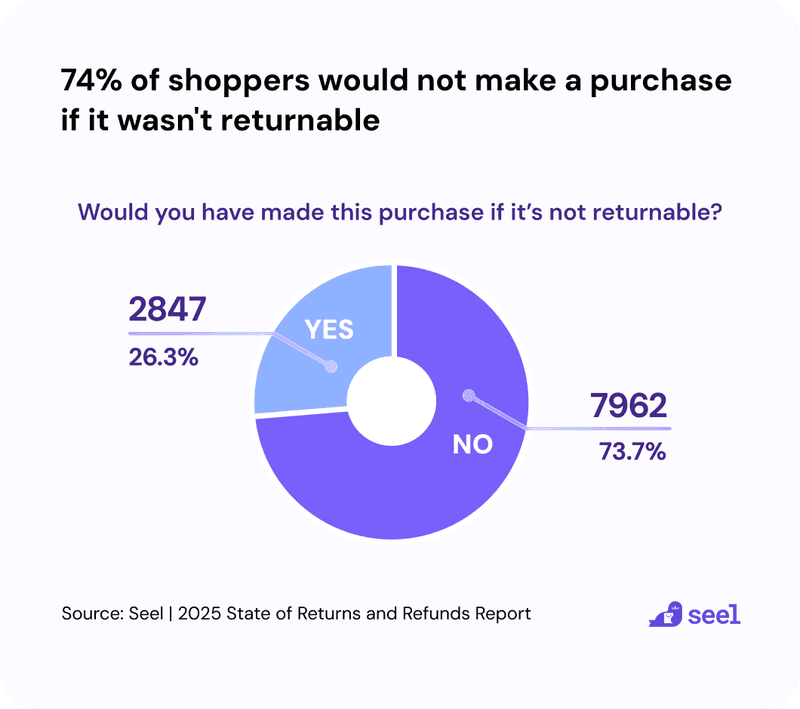
Fast and fair refunds are increasingly viewed as part of the product itself. Smooth experiences fuel conversion and repeat purchases, while slow or unclear processes lead shoppers elsewhere.
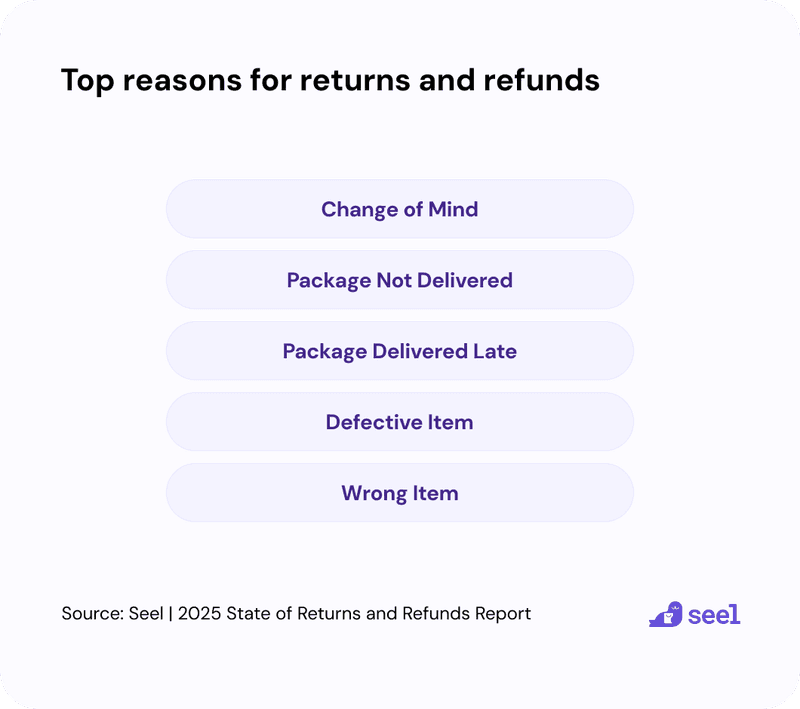
Top reasons for returns and refunds.
Based on Seel’s platform data, delivery failures have emerged as the dominant driver of returns, accounting for three-quarters of all return requests.
Addressing delivery reliability and assurance offers merchants one of the highest-leverage opportunities to protect margins, and preserve customer trust during peak season and beyond.
The breakdown of return reasons points to where retailers should focus their operational improvements:
Change of Mind
Package Not Delivered
Package Delivered Late
Defective Item
Wrong Item
Holiday shopping drives a sharp rise in returns.
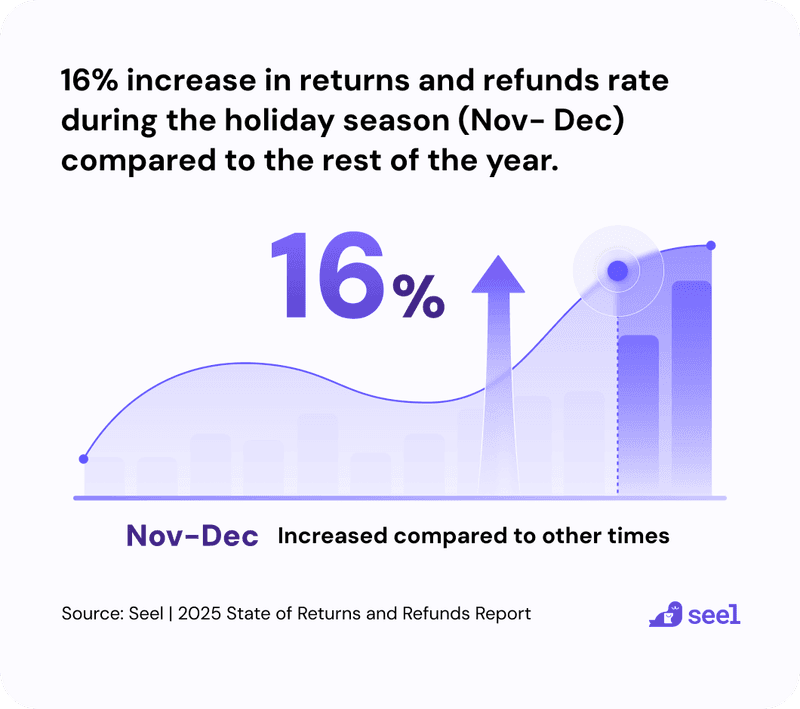
The holiday shopping season remains the most operationally intensive period for retailers, amplifying both sales opportunities and post-purchase strain. Seel’s analysis reveals that return activity increases 16% during November and December compared to baseline months.
Key patterns shaping the season:
Return activity increases 16% during the holiday shopping season
Shoppers are buying earlier, returning sooner and expecting faster refunds
Nearly one in three shoppers using return protection returned at least one item in the last year, with a smaller group returning multiple items across categories
Returns continue to be one of the largest pressure points on retail profitability. Once reverse logistics, processing systems, customer support, and restocking operations are included, returns and refunds consume 20–25% of revenue.
The peak season signal
Holiday returns provide retailers with one of the clearest views into where the industry is headed next:
More volume online
Higher expectations around speed and transparency
Increased exposure to fraud and abuse
Mounting pressure on profitability
Retailers that prioritize post-purchase as part of their core experience will be better positioned to grow, even amid rising returns.
Secondhand is growing, and so are the returns
Resale is one of retail’s fastest-growing sectors, but shoppers still hesitate to buy secondhand — despite great deals — because they often aren’t offered a return path.
In Seel’s shopper research, over 70% of secondhand customers said they would not have completed their purchase without a return option.
The hesitation makes sense. Pre-owned items come with more uncertainty which directly suppresses conversion. The condition of pre-loved goods, uncertainties about fit and authenticity, and unclear or restrictive policies all directly suppress conversion.
Across our data, Seel sees 140% higher return rates on secondhand items, further validating the challenges resale merchants and marketplaces face when considering offering shoppers a return path themselves.
Post-purchase protection removes this friction and gives shoppers a clear, trusted return option that eliminates the biggest barrier to conversion.
Flexible post-purchase policies remove the risk from product, shipping, and return issues. Shoppers become more confident and merchants spend less time processing returns and managing customer support tickets, allowing retailers to treat resale as a recurring revenue stream rather than just a seasonal experiment.
Delivery tension: Fashion vs. Electronics.
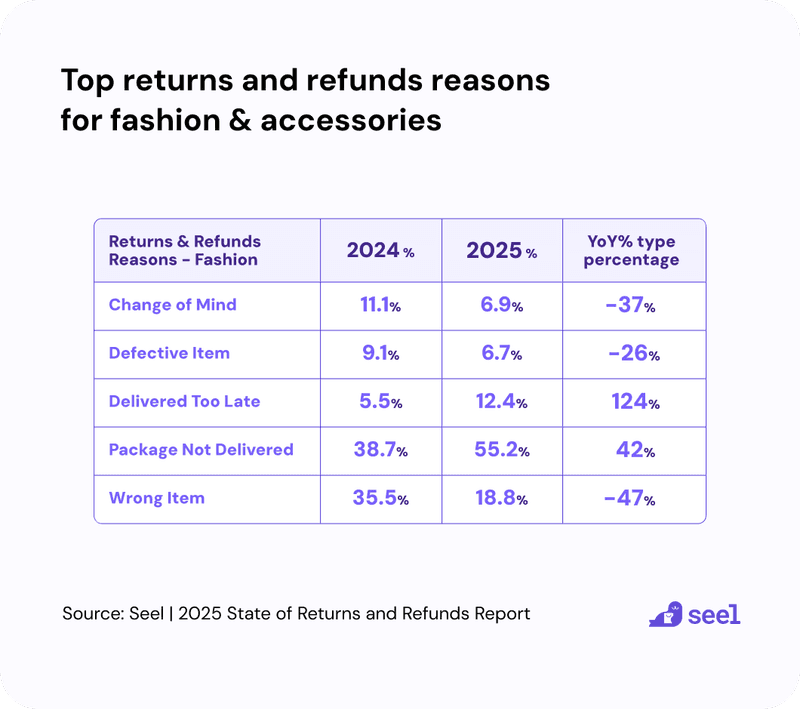
Seel’s category-level data shows that returns stem from fundamentally different issues in Fashion vs. Electronics:
In Fashion & Accessories, delivery issues loom large, but show progress in getting the item delivered right:
“Delivered too late” returns jumped 124% YoY
Missing package claims increased 42%
Wrong-item errors improved, with “Item wrong” down 47%
In Computers & Electronics, product performance drives more returns:
Defective item returns climbed 33% YoY
Undelivered items rose 13%, even as late deliveries dropped 45%
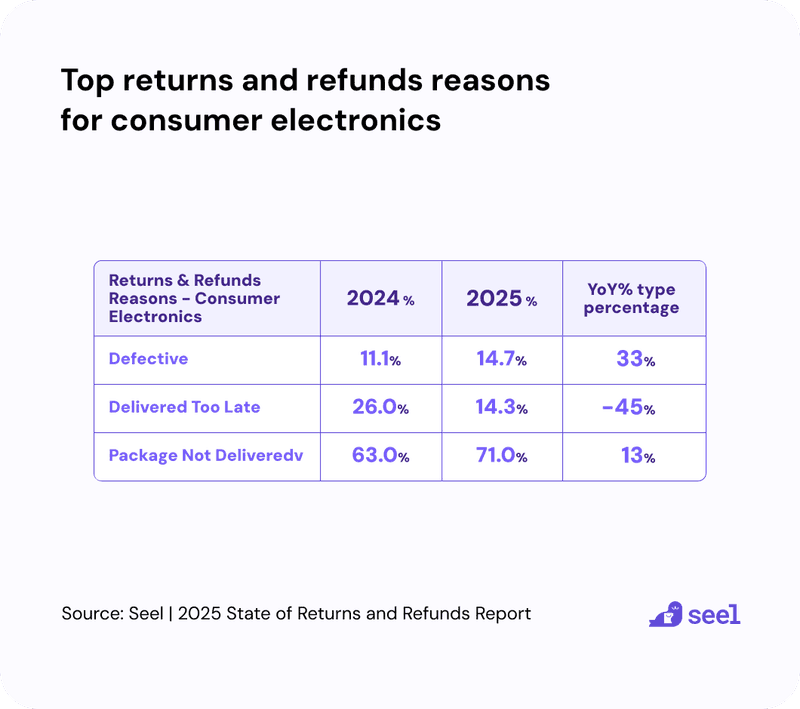
These category-specific pressures show why a single, generic returns policy cannot effectively address the underlying causes. Nor does a blanket fix for return challenges. Merchants need a data-aware, category-specific post-purchase strategy, especially during peak season.
How brands can build a sustainable, competitive advantage
The most successful brands are discovering that competitive advantage increasingly comes from the post-purchase experience rather than marketing or product differentiation alone.
Deliver a frictionless post-purchase experience
A seamless returns and refund process earns trust, the kind that drives repeat purchases and organic advocacy. Customers remember how brands handle friction as much as how they sell the product.
Leverage the compounding data advantage
Every return offers signals that improve forecasting, merchandising and service. Over time, this creates a feedback loop that lowers return rates and elevates customer satisfaction.
Seel helps retailers shift move away from post purchase as damage control
Seel’s agentic post-purchase platform helps merchants move beyond reactive returns management.
Reduce direct exposure on returns and refunds
Seel handles return and refund requests, underwrites the risk and manages the underlying workflows so those costs don’t sit squarely on the retailer’s P&L.
Use AI to spot issues before they snowball
By analyzing patterns across millions of orders, Seel helps merchants detect spikes in defects, shipping problems, or abuse before they escalate.
Boost confidence at checkout
With Seel’s AI-powered Worry-Free Purchase® program, merchants can make higher-consideration or final-sale items easier to buy, lifting conversion and order value.
All of this is anchored in one goal: a post-purchase experience that protects margins while strengthening the customer relationship.
Looking ahead
As customer acquisition costs rise and differentiation becomes increasingly difficult to maintain, the post-purchase experience represents one of the most durable levers for competitive advantage. Brands that recognize this shift and invest accordingly will be better positioned to win both revenue and loyalty in the year ahead. To discover how Seel can power Worry-Free Purchase® and incremental growth for your brand, visit seel.com to book a demo with our team.
The most successful brands are discovering that competitive advantage increasingly comes from the post-purchase experience rather than marketing or product differentiation alone.
Deliver a frictionless post-purchase experience
A seamless returns and refund process earns trust, the kind that drives repeat purchases and organic advocacy. Customers remember how brands handle friction as much as how they sell the product.
Leverage the compounding data advantage
Every return offers signals that improve forecasting, merchandising and service. Over time, this creates a feedback loop that lowers return rates and elevates customer satisfaction.