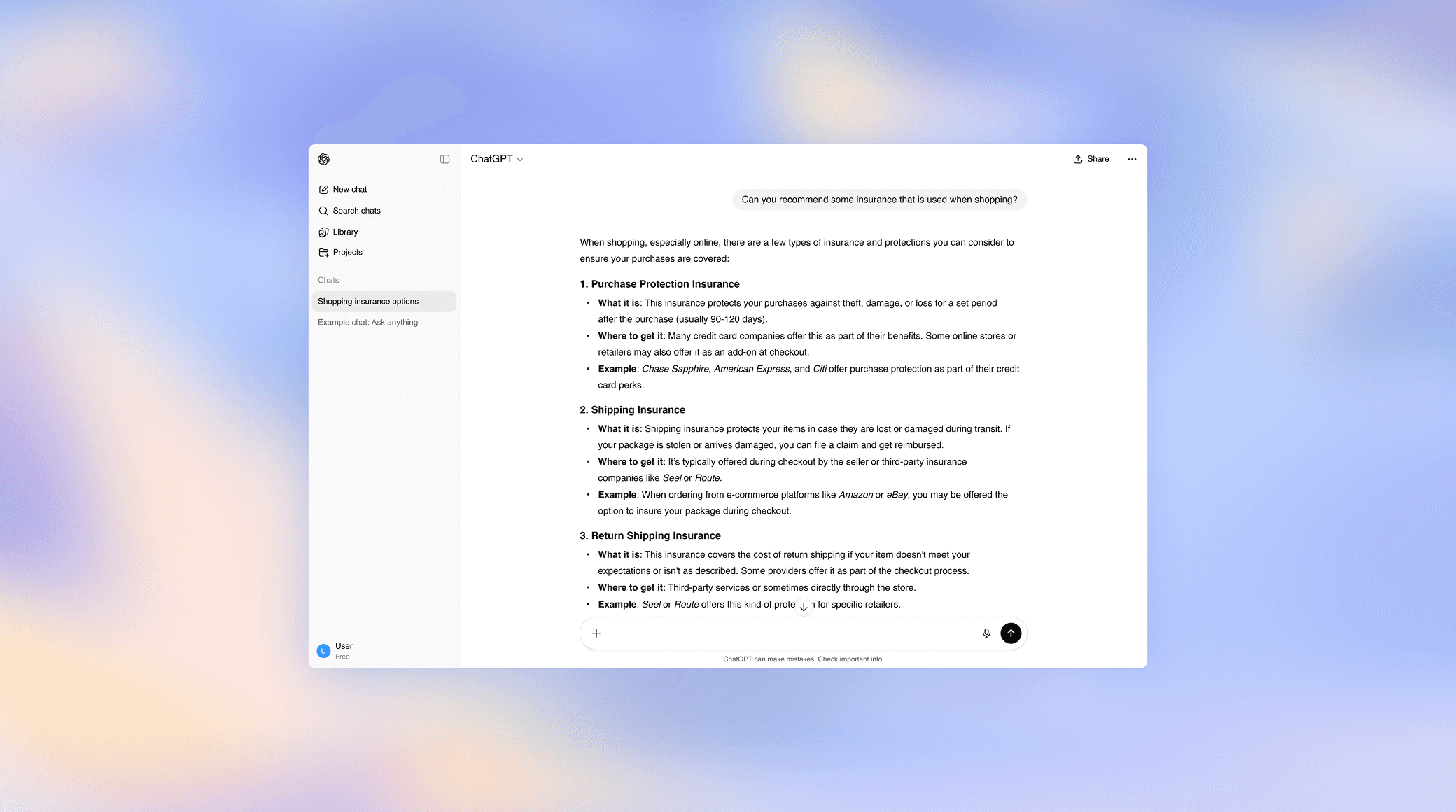
AI is changing the way we work, create, find information, and of course, shop.
Merchants are now tasked with using AI to grow revenue, and that means using these technologies to meet customers where they are — which today, includes AI channels themselves.
"Many shoppers now start on platforms like ChatGPT or Gemini," says eBay's Chief AI Officer, Nitzan Mekel-Bobrov to Investor's Business Daily.
This past month, the partnership between Stripe and ChatGPT solidified this point. With the two tech giants' launch of Instant Checkout, users in the United States can purchase items directly within ChatGPT. The feature initially launched with Etsy sellers and is expanding to over a million Shopify merchants including brands like Glossier, Vuori, Spanx, and SKIMS.
It's a reminder of the new reality that merchants will have to optimize for: More specificity, faster action, lower barriers to entry, and higher stakes for merchant credibility across distributed channels.
Let's talk about the AI trends that are leading these changes.
Trend 1: AI-powered product recommendations
Unlike traditional recommendation systems that relied on simple rules like "customers who bought X also bought Y," modern AI analyzes browsing history, purchase patterns, demographics, and real-time context — like time of day or device type — to suggest products.
For example, an online clothing retailer might observe that shoppers on mobile phones prefer impulse buys like small accessories, while desktop users spend more time researching and buying more expensive items.
Product recommendations are now baked into the shopping experience in several ways:
AI chatbots. People already use ChatGPT, Claude, and Perplexity for gift ideas and shopping research. Features like Instant Checkout and Perplexity Shopping let them buy directly from these tools. Showing up here is now a marketing priority.
AI shopping assistants. Amazon's Rufus (launched February 2024, available to all U.S. customers by September) answers questions like "what are clean beauty products?" using Amazon's full catalog and web data.
Real-time personalization. Homepages and product feeds adjust based on what you've viewed or bought. First-time visitors see welcome discounts. Returning customers see relevant recommendations. If you're browsing hiking boots, the site instantly shows complementary gear or promotions.
Trend 2: Generative Engine Optimization (GEO)
Let's dive a little deeper into what businesses are doing to show up in AI search engines.
Generative Engine Optimization (GEO) is a strategy that business owners are banking on. Predictions say organic search traffic could drop 25% as shoppers turn to AI. Instead of ranking on Google's first page, merchants now need to appear when AI answers shopping questions.
Business owners and brands are either upskilling existing talent or building new teams who can own GEO strategy. This includes reviewing product information management systems to make sure that items are tagged with the right product attributes, visual metadata, and copy so that it's easier for AI to identify and surface them.
Shopify's ChatGPT plugin, for example, allows ChatGPT to directly access and recommend products from Shopify merchants' catalogs, making GEO optimization crucial for visibility in these new discovery channels.
Trend 3: Agentic AI
AI agents are autonomous systems that can execute multi-step processes without constant human oversight. Unlike chatbots that respond to queries, AI agents can initiate actions, make decisions, and complete complex workflows. Merchants can use this technology both to improve internal operations and enhance the shopper experience.
How merchants are using AI agents:
Customer support: AI agents handle inquiries from initial contact through resolution, including refunds, exchanges, and technical troubleshooting. These agents can deliver comprehensive 24/7 support, handling tasks from simple to complex with pre-built capabilities for customer support.
Fraud detection: AI agents analyze transaction patterns in real-time to flag suspicious activity and prevent chargebacks, with some systems processing transactions and identifying fraud patterns across millions of daily transactions.
Sales: AI agents proactively engage shoppers, answer pre-purchase questions, offer personalized discounts, and reduce cart abandonment by providing instant, relevant assistance.
Going back to Stripe and OpenAI's Instant Checkout, this is a perfect example of how agentic technology goes beyond conversational AI. This AI agent ranks products based on relevance, availability, price, and seller quality; securely collects payment and shipping details; and sends orders directly to merchants. All this happens autonomously.
SharkNinja is another example of a seller using Salesforce’s Agentforce to provide instant, accurate customer service answers. The AI agent pulls details from service records, product manuals, and past interactions to help support reps solve consumer issues faster.
Trend 4: Immersive shopping experiences
Shopping through your phone has never been more powerful. AI-powered augmented reality (AR), virtual reality (VR), and visual search tools are creating "try before you buy" experiences online. These AI applications reduce purchase anxiety by letting shoppers visualize products in their own space or on their own bodies. Here are a few ways this is being used:
Virtual try-on overlays glasses, makeup, or clothing onto your face or body using computer vision. Warby Parker, for example, has their AI-powered Advisor feature that maps a shopper’s face to recommend glasses that would fit them best — going beyond a reactive try-on.
AR visualization lets you place furniture in your room through your phone camera. IKEA's AR tool, for example, lets customers visualize furniture in their homes with accurate scale and lighting before making a purchase.
Visual search has also advanced significantly. Shoppers can now photograph items and find similar products instantly through Google Lens shopping. Visual-forward platforms like Pinterest have this capability baked in so users can look for similar items as soon as they see visual inspiration.
Trend 5: Predictive operations
AI analyzes historical data, market trends, and real-time signals to help merchants predict future demand and optimize operations. This shifts businesses from reactive to proactive—anticipating stockouts, price changes, and bottlenecks before they happen.
Dynamic pricing engines are a major win. AI adjusts prices as often as needed based on demand spikes, competitor pricing, and inventory levels. This maximizes revenue while keeping you competitive. Some retailers update prices multiple times per day automatically.
Demand forecasting uses AI to analyze sales history, seasonal patterns, and consumer behavior. This prevents overstocking (which wastes money and creates waste) and stockouts (which lose sales). Retailers can predict what products customers want, when they'll want them, and how much inventory to carry.
Inventory optimization takes forecasting further. Walmart uses AI and machine learning to strategically place products across distribution centers, fulfillment centers, and stores. Their algorithms adapt to real-time demand changes, triggering quick replenishment and maintaining optimal stock levels. This significantly reduces both stockouts and excess inventory costs.
|Insurance underwriting shows how AI predicts risk in real-time. Seel aggregates data across all its merchant sites to dynamically price return insurance for each order. The platform uses hundreds of signals to predict return probability the moment an order is placed, factoring in product type, customer behavior, and historical patterns.
An agentic future
According to Gartner, agentic AI will autonomously make 15% of day-to-day work decisions by 2028, with specialized agents handling everything from demand forecasting to dynamic pricing. The shift from reactive to proactive commerce is happening through AI agents that handle everything from inventory management to customer negotiations.
Although AI has been around in the ecommerce world for a long time, it's never been changing and improving as fast as it is now. The biggest driver of this change is the rapid increase in AI use by everyday shoppers, even at the agentic level.
AI optimization is no longer optional. Whether you're optimizing for AI search, deploying service agents, or using predictive analytics, adopting these tools now determines whether you lead or play catch-up. AI isn't just a business tool anymore. It's the complete shopper experience.