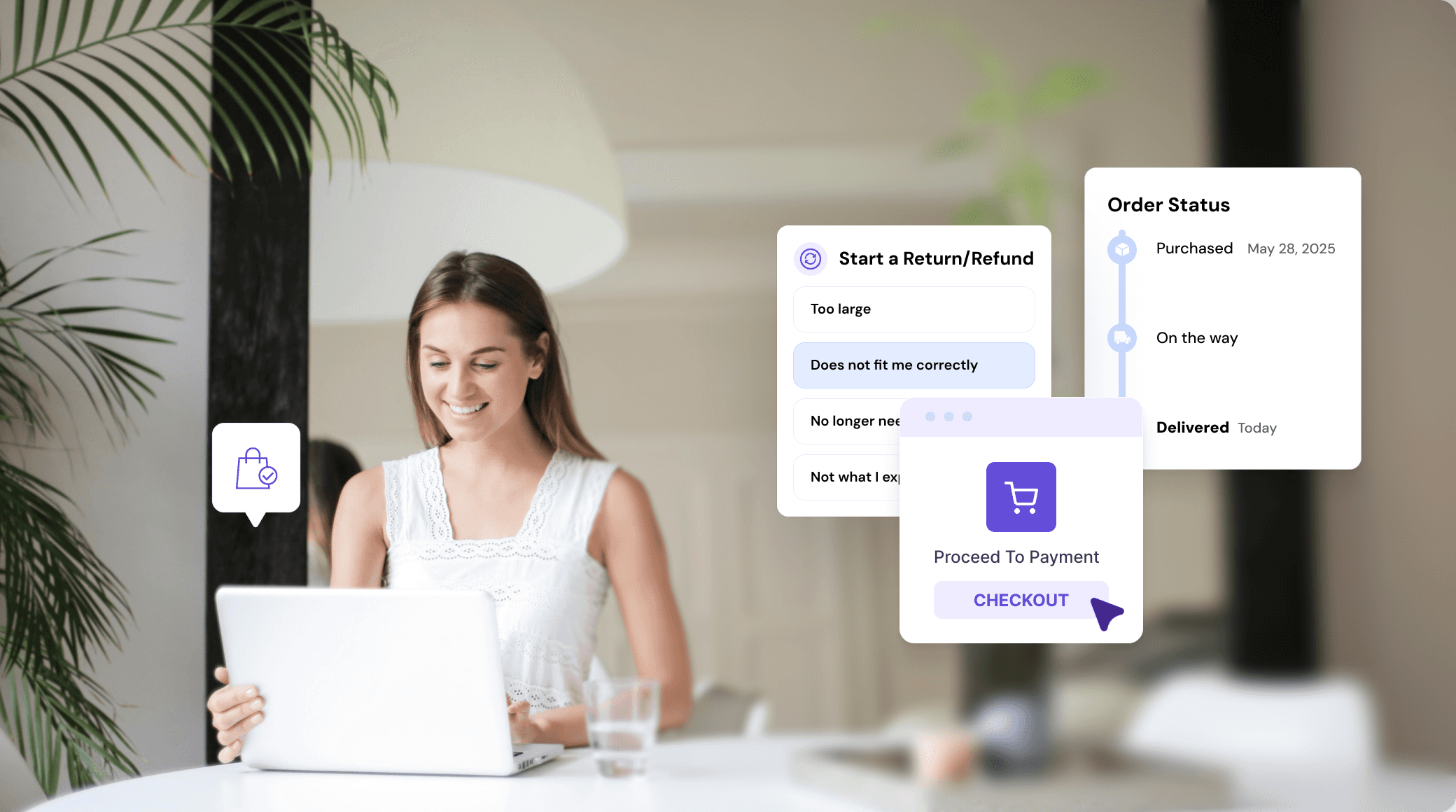
You could say that winning customers over with great products is a straightforward game. But that's not enough to keep customers. Putting items into a cart is easy. Exciting even. Clicking checkout? Also easy, and even more exciting.
The tension starts after the order is made.
Experiences are formed during this waiting game and solidified after the order arrives. This is where brands either build lasting relationships or watch customers slip away. And yet, post-purchase remains a tough nut to crack.
93% of consumers consider the post-purchase experience to be just as important as the purchase experience.
But the state of post-purchase is on the decline. Shoppers today have convenience at their fingertips, and they expect that same level of instantness from the post-purchase experience. Merchants, on the other hand, are operationally challenged to meet this demand.
As the channels to reach customers continue to multiply, it's important that merchants don't lose sight of how fragmentation impacts post-purchase too.
This article dives into what's broken in post-purchase today and why it can't be overlooked.
The cost of poor post-purchase experiences.
Poor execution of the post-purchase experience costs merchants more revenue in the long run.
Losing existing customers isn't a model built for growth. Customer acquisition costs for e-commerce brands have increased by 40% over the past two years alone. It's become more expensive to effectively target digital advertisements given stricter consumer privacy standards like iOS 14.5, the demise of third-party cookies, and regulations like CCPA and GDPR. These changes have reduced targeting precision across social media platforms, where 25% of all digital ad spend now goes.
"Some brands now find it cheaper to acquire new customers by delivering personalized paper catalogs to their homes rather than acquire them via digital advertising," comments Jordan Jewell, analyst at VTEX, in regard to research published on costs impacting e-commerce profitability.
With merchants losing a staggering $29 per new customer acquired — compared to just $9 in 2013 — the value of keeping existing customers happy has never been more apparent.
Pouring money into retention and not acquisition seems like the most cost-efficient route, right?
Not exactly. Keeping existing customers happy means investing in their baseline expectations, with easy returns being one of them.
Shoppers have come to expect the seamless, no-questions-asked returns of brands like Amazon, Target, and Costco. Without that safety net, conversion rates suffer and loyalty erodes.
The returns reality.
But for many merchants, making the returns process hassle-free isn’t as easy. It’s a sizable amount to capture and operationalize, opening up into a web of additional processes that many merchants aren’t equipped to handle.
Consumers returned products worth $890 billion in 2024, accounting for 16.9% of total retail sales.
The average return costs a retailer $30, and the cost of processing a return has tripled since the pandemic.
For every $100 in returned merchandise, retailers lose $10.30 to return fraud.
Merchants find themselves in a catch-22: losing money to high acquisition costs while simultaneously losing money to returns as customer volume grows.
The common denominator to solving both problems? A strong post-purchase experience optimized to build customer trust while reducing the operational costs of returns.
The vendor juggling act.
To complete a single end-to-end return fulfillment process, merchants often need to coordinate across multiple vendors:
Shipping carriers for initial delivery and return logistics
Warehouse partners for receiving and processing returned inventory
Customer service platforms for managing return requests
Payment processors for issuing refunds
Fraud prevention tools to flag suspicious returns
Inventory management systems to track returned products
Relisting services to resell returned items
Each vendor brings its own dashboard, pricing structure, and integration requirements. Managing transactions at scale call for merchants to dedicate more time and headcount into managing operational complexity instead of growth.
With acquisition channels multiplying and operational demands intensifying, many merchants feel compelled to prioritize marketing spend over enhancing their return infrastructure. The thinking goes: "If I can just get more customers in the door, the returns problem will sort itself out."
But it doesn't. And customers notice.
Customers don’t see fragmentation, they see a poor experience.
When post-purchase experiences are unreliable — slow shipping updates, complicated return processes, unresponsive customer service — it kills loyalty. Shoppers expect to track orders seamlessly, return items easily, and receive responsive support when problems arise.
Research shows that despite accounting for only 21% of a brand's audience, loyal customers contribute 44% of total revenue. These are the customers who come back repeatedly, refer friends, and advocate for your brand. But loyalty is fragile, especially in an era where switching costs are zero and competitors are just a click away.
A single frustrating return experience can undo months of brand building. A customer might love your product, appreciate your marketing, and enjoy the checkout experience. But if returning a wrong-sized item requires multiple emails, unclear instructions, and weeks of waiting for a refund, they'll remember that friction far more than the initial delight.
Turning post-purchase from a cost center to a revenue driver.
If returns are such an ingrained part of the shopping experience, what if merchants could turn shopper protection into a value-add?
This shift in thinking transforms returns from a pure cost center into a strategic advantage. Instead of absorbing the full financial burden of returns while trying to meet customer expectations for easy, seamless service, merchants can offer return protection as an opt-in feature at checkout.
Modern return protection solutions like Seel allow merchants to:
Shift the in-house support burden: Customers can add return coverage for a small fee, giving them confidence to complete purchases they might otherwise abandon. For final sale items, one-of-a-kind products, or high-ticket purchases, this coverage removes the primary objection to buying.
Shift the in-house support burden: When customers opt into return protection, a third party handles the claims process, refunds, and customer service. The Hat Shack, for example, saw a 50% drop in shipping tickets after implementing this approach with Seel.
Generate new revenue streams: Return protection becomes a revenue generator, not just risk mitigation. A significant percentage of customers opt in, creating a new income stream that directly offsets the rising costs of acquisition and operations.
Build customer trust strategically: The mere presence of a “return for any reason” option increases conversion rates, even among customers who don't purchase the coverage. It signals confidence in your products and commitment to customer satisfaction.
The path forward for post-purchase.
Look at post-purchase as the beginning of customer lifetime value. Every order confirmation, shipping notification, delivery, and return interaction is an opportunity to either strengthen or weaken the relationship with your customer.The brands that will thrive in this environment are those that:
Unify the post-purchase experience across all sales channels
Turn operational challenges into strategic advantages by offering customer-funded protection
Use post-purchase data to inform product, marketing, and inventory decisions
Invest in retention with the same rigor they apply to acquisition