
Brian Wisniach
Content Marketing
TL;DR:
Recommerce means giving returned or unwanted inventory a second sale through online marketplaces.
Resale is shifting from something a shopper does elsewhere to something they expect a brand to offer directly.
Recommerce only works if the operational pipeline behind it (grading, pricing, listing, payout) is actually built for it. Bolting a “sell it back to us” link onto your site isn’t a recommerce program.
What is recommerce?
Ask five people what recommerce means, and there’s a good chance you'll get at least three different answers. That's a problem, because each of those answers require merchants to think about different infrastructures. Optimize for the wrong one, and you'll have spent months solving a logistics problem that isn't yours.
Peer-to-peer resale (eBay, Poshmark, Depop) is a shopper selling to another shopper, with the brand nowhere in the transaction. A take-back or donation program moves an item out of circulation, not back into a sale.
Recommerce refers to a brand or shoppers reselling returned or owned inventory via through online marketplaces — often times, the very platforms that facilitate peer-to-peer resale. It's a sustainable method of disposal that helps excess inventory go to the right channels to be reused, recycled, or resold.
Some brands also partner with recommerce providers and platforms to take on the logistics of reselling excess inventory. These platforms manage a business model known as resale-as-a-service (RaaS).
What is true about each of these different mechanisms is that they're all part of a broader movement toward more sustainable approaches to attaining and disposing commerce inventory — especially in the fast-moving realm of e-commerce. The circular economy is becoming more accessible for brands to take part in, and they can do so by reimagining returns and post-purchase engagement with shoppers.
Secondhand shopping has gone mainstream
Secondhand stopped being a niche a while ago, and the data below lays out just how far it's actually come. In the past year, over half of Gen Z bought resale online as a regular habit, compared to 53% of Millennials and 26% of Gen X. What’s more telling is why.
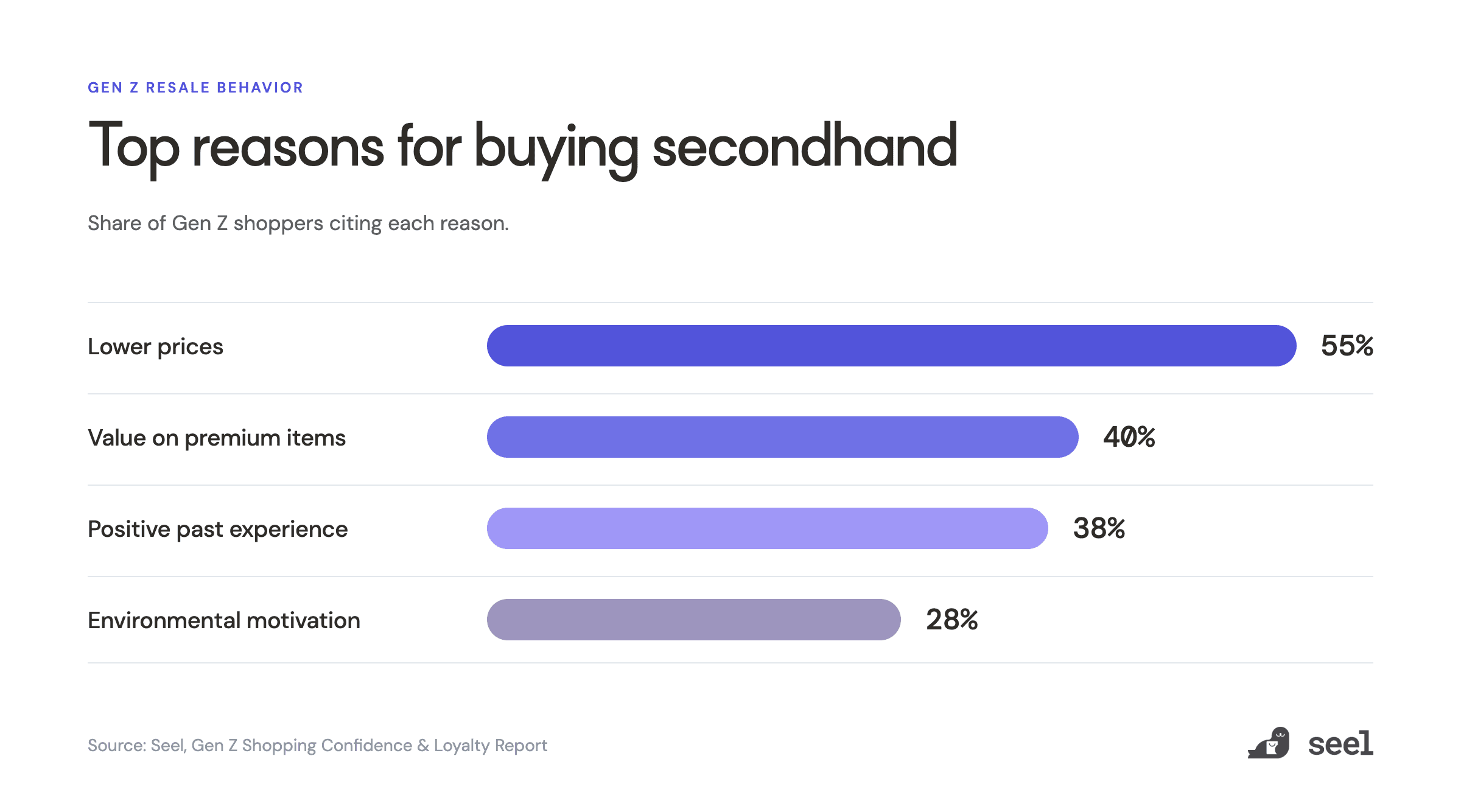
Notice that sustainability is in there, but it’s far from the headline reason most people are actually buying.
The market’s catching up to that behavior. ThredUp’s 2026 Resale Report puts the global secondhand apparel market at $393 billion by 2030, growing roughly twice as fast as the overall apparel market. That’s the multi-year global trajectory. Zoom into just 2025 in the U.S. specifically, and the gap gets sharper still: secondhand apparel there grew nearly four times faster than the broader retail clothing market in that single year.
Two different ways of slicing the same trend, and they both point the same way. Retail is not setting the pace here anymore.
The hidden cost of making shoppers do the work themselves
This is what shoppers are up against on a DIY resale platform. Send in a batch of clothes, wait weeks for a response, and it’s not unusual to come back with something like $12 for 32 accepted items, after fees and shipping deductions eat most of what was left.
Reviews of the bigger consignment platforms tell a consistent version of the same story:
Multi-week payment delays
Items listed with cropped or misleading photos that don’t match what was actually sent in
Little visibility into what happened to anything that wasn’t accepted
Shoppers keep showing up for resale, that much is already clear. But a clunky process can look a lot like demand drying up, if you're not looking closely. So, every one of those bad ThredUp experiences above is potentially a shopper who wanted to keep buying and reselling, just not from you. Most likely, someone else made it easy and got the business instead.
Build your own recommerce program, or plug into one that already exists?
Once the case for offering resale is made, the actual build is where most of the real decisions live.
Build in-house | Run through a managed partner | |
Grading and pricing | Your team builds the logic from scratch | Comes pre-built, tuned across other merchants’ data |
Listing and payout | Custom development, ongoing maintenance | Already integrated, no separate storefront |
Shopper-facing experience | A new tool shoppers have to learn | Lives inside an experience shoppers already use |
Time to launch | Months, plus ongoing engineering | Weeks, mostly configuration |
There’s also a connection worth making that most merchants miss entirely: resale and returns are the same operational pipeline pointed in two forking directions. Secondhand items see 140% higher return rates than new merchandise, and over 70% of secondhand buyers say they wouldn’t have completed the purchase without a return option in the first place.
A returns system and a resale system that don’t talk to each other are duplicating work that could be feeding each other instead.
Whichever path you pick, these five questions decide whether it actually works:
Which products actually have resale demand?
Where does supply come from: returns, trade-ins, or owned inventory?
What grading and quality standard decides what's resellable at all?
Where does it actually sell: your own storefront, or a separate resale-specific one?
Does this plug into systems you already run, or does it need its own?
This already exists… you just haven't turned it on.
Most merchants solve this by adding a tool, but the strategic move is connecting the ones you've already got. Seel’s Resale Agency is one example of the managed-partner path, letting shoppers resell through the same Resolution Center they already use for returns and protection claims, without a separate vendor integration to stand up.
If you’re weighing whether to build this yourselves or hand it to a partner, talk to sales, and we’ll walk through what your own return and resale data actually supports.
Frequently asked questions about recommerce
What’s an easy way to start a resale program?
Start with a managed partner rather than building the grading, pricing, and payout logic from scratch. It gets a real program live in weeks instead of months, and it’s a lower-risk way to learn what your own resale demand actually looks like before investing in custom infrastructure. You could also use a solution like Seel's Resale Agency for an AI-powered workflow that takes off the work off your plate while giving shoppers a commision-free mechanism to reclaim the cost of unwanted goods as an add-on benefit of shopping with you.
Which apps help stores manage returned inventory efficiently?
Look for a platform that treats returns and resale as connected, not separate tools. Seel’s Resale Agency is one example; it runs on the same infrastructure as returns and shipping protection, so inventory can move directly into a resale flow past their return window instead of sitting in a separate system.
Is there a recommerce option that integrates with an existing checkout?
Yes. Resale typically surfaces after a return window closes rather than at the checkout button itself, but a well-integrated one connects to the same checkout and order data you’re already running, without a standalone integration. We cover the mechanics of checkout-level integration in more depth in our guide to checkout integration.
What should a growing apparel brand look for in a resale platform?
Fit matters more than feature count. Look at how REI's Re/Supply program handles this: a clear, published condition scale (from "excellent" down to "well worn," with hard exclusions for anything altered, damaged, or missing functional parts), a payout structure shoppers can actually predict (up to 50% of resale value as store credit), and a shopper-facing experience that lives inside REI's existing site rather than a bolted-on tool.
Worth noting too: REI hasn't run all of this in-house. For at least some of its brand partnerships, like a 2021 collaboration with Cotopaxi and NEMO, REI provided the storefront while a dedicated recommerce partner handled grading, cleaning, and condition assessment behind the scenes. A real-world version of the build-vs-partner choice covered above.